
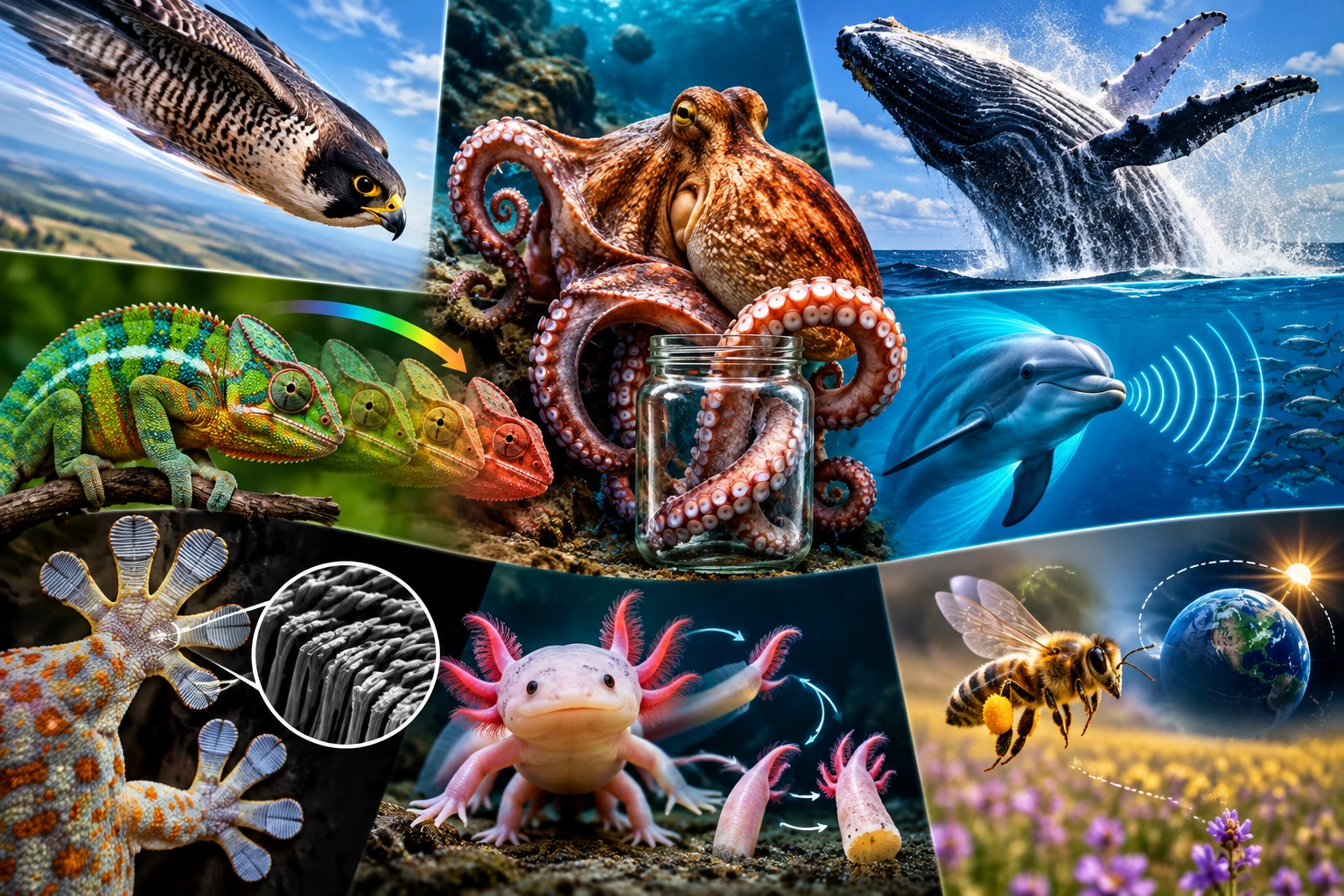
The animal kingdom is full of extraordinary abilities that can seem almost impossible to humans. Some creatures can regenerate lost body parts, others can detect invisible signals, and certain animals can survive environmental conditions that would be dangerous to most living things. These remarkable adaptations have developed over millions of years, helping animals find food, avoid predators, and survive in challenging habitats. Discovering how these abilities work reveals the incredible diversity of life on Earth.
1. Octopuses Can Change Their Color and Texture
Octopuses are famous for their ability to change their appearance in seconds. Their skin contains specialized cells, including chromatophores, that help them produce different colors and patterns. Other structures contribute to changes in skin texture.
These adaptations allow octopuses to blend into rocks, coral, and the ocean floor. Camouflage can help them avoid predators and approach prey without being easily noticed.
Some octopuses can also squeeze through surprisingly small openings because they have no rigid internal skeleton. Their beak is one of the main limitations when passing through a narrow space.
What makes this ability especially fascinating is that an octopus can combine camouflage, flexible movement, and problem-solving skills to navigate its surroundings.
2. Axolotls Can Regrow Lost Limbs
The axolotl is an aquatic salamander known for its remarkable regenerative abilities. If it loses a limb, it can regrow the missing structure, including bones, muscles, nerves, and other tissues.
Unlike ordinary wound healing, regeneration involves rebuilding complex body parts in an organized way. Scientists study axolotls to understand how cells respond to injury and how tissues can be reconstructed.
Research into these processes may eventually contribute to a better understanding of human tissue repair. However, humans cannot currently regenerate entire limbs in the same way as axolotls.
This extraordinary ability makes the species an important subject in regenerative biology and medical research.
3. Bats Navigate Using Sound
Bats are capable of flying through dark environments while detecting obstacles and locating prey. Many species use echolocation, a biological system that involves producing sounds and interpreting the returning echoes.
A bat sends out high-frequency calls and listens for echoes bouncing off objects. Differences in the returning signals help it estimate an object’s location, distance, size, and movement.
This system can be so precise that some bats can detect tiny flying insects in darkness. Their ability to interpret acoustic information helps them hunt and navigate when ordinary vision is limited.
Bats demonstrate how animals can develop sensory systems that provide information beyond the limits of human hearing.
4. Electric Eels Can Generate Powerful Electrical Discharges
Electric eels, which are actually a type of knifefish, can produce electricity using specialized cells called electrocytes. These cells work together to generate electrical discharges.
Depending on the species and circumstances, electric discharges can help with hunting, defense, and sensing the environment. Strong discharges can stun prey and discourage potential threats.
Electricity production is an impressive biological adaptation because it allows an animal to influence its surroundings without direct physical contact.
Scientists study electric fish to better understand bioelectricity, nerve signaling, and how specialized cells coordinate their activity.
5. Tardigrades Can Survive Extreme Conditions
Tardigrades, sometimes called water bears, are microscopic animals known for their remarkable resilience. Certain species can survive conditions that would be fatal to many other organisms when they enter a specialized dormant state called anhydrobiosis.
During this state, they lose much of their body water and dramatically reduce their metabolic activity. Some tardigrades can then tolerate extreme dehydration, very low temperatures, and other stressful conditions.
However, they are not indestructible. Their survival depends on the species, the type of stress, and how long the exposure lasts. Not every tardigrade can survive every extreme environment.
Their resilience has attracted scientific interest in the mechanisms that protect cells and biological molecules during severe environmental stress.
6. Mantis Shrimps Have Extraordinary Vision
Mantis shrimps are marine crustaceans with highly specialized eyes. Many species possess numerous types of photoreceptor cells and can detect different aspects of light, including ultraviolet wavelengths.
Their eyes can also detect polarized light, which is light whose waves vibrate in particular directions. This ability may help them identify objects and communicate with other mantis shrimps.
Although their visual systems differ greatly from human vision, having more types of photoreceptors does not automatically mean they see a richer or more detailed world in every respect.
Their unusual eyes offer researchers valuable insights into how biological visual systems process light and recognize environmental signals.
7. Archerfish Can Shoot Water to Catch Insects
Archerfish have developed a remarkable hunting technique that allows them to capture insects resting above the water. They aim their mouths toward a target and forcefully expel a stream of water, knocking the insect into the water where it can be eaten.
Accurate shooting requires the fish to account for the target’s position above the water surface. Light changes direction as it passes between water and air, making visual targeting more complicated than it first appears.
Archerfish can learn to improve their accuracy through experience. Researchers study them to explore animal learning, visual perception, and how creatures adapt their behavior to solve practical challenges.
This ability shows that sophisticated hunting strategies are not limited to mammals or birds.
Why Are Animal Abilities So Remarkable?
Animal abilities develop through evolution, with traits that improve survival and reproduction becoming more common across generations. Different environments create different challenges, leading to a wide range of adaptations.
Some animals rely on specialized senses, others use chemical or electrical signals, and some possess unusual ways of repairing tissue or tolerating environmental stress.
Studying these abilities can also inspire research in robotics, medicine, materials science, and environmental technology.